Working Visa (KITAS) – Who is it for and what are the benefits?
The Working Visa / Working KITAS is intended for foreigners that are employed to work in Indonesia for more than a few months. It is the most comprehensive working permit you can get and allows the user to actively earn income, open bank accounts, pay taxes, get a mobile phone etc.
To obtain a working permit you need to work for a company that is registered within Indonesia. This entity can be either a Foreign Owned Company (PMA), a Representative Office or an Indonesian Owned Company.
The length of your working visa can vary between 6 & 12 months depending on your job title; the validity being approved by Indonesia’s Ministry of Manpower. In general, Directors, Commissioners & Senior Managers can obtain a 12-month extendable permit, whereas advisors can only get a 6-month, non-extendable visa.
If you need to know more about different types of legal entities or you do not have a company set up within Indonesia yet, please check out our Company Establishment Page.
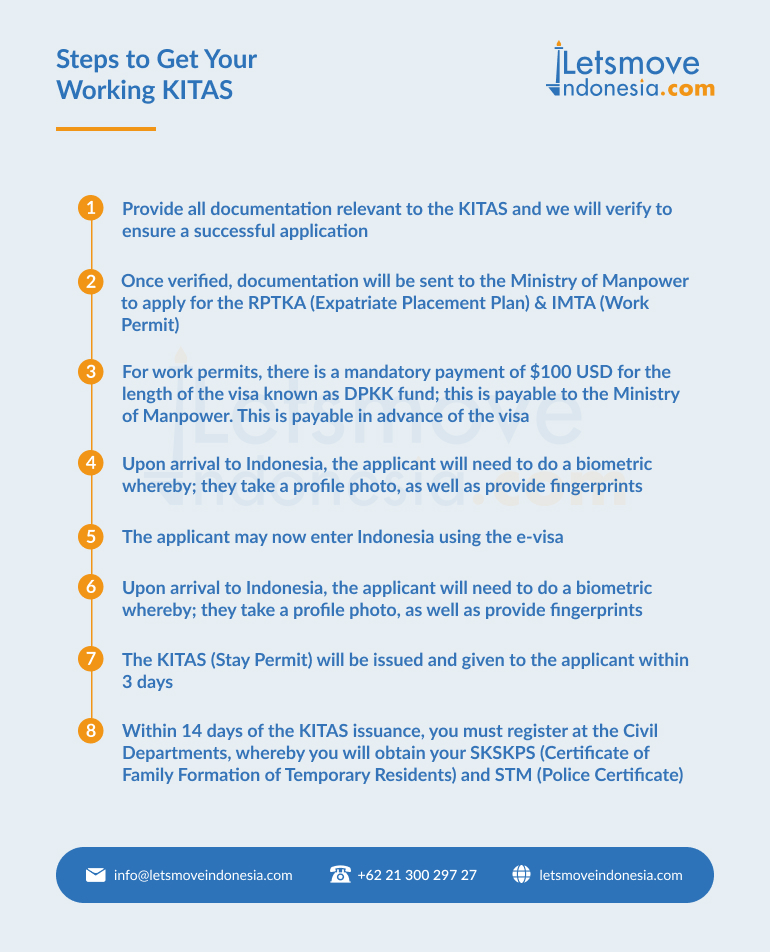
8 Steps to Get Your Working KITAS
Provide all documentation relevant to the KITAS and we will verify to ensure a successful application.
Once verified, documentation will be sent to the Ministry of Manpower to apply for the RPTKA (Expatriate Placement Plan) & IMTA (Work Permit).
For work permits, there is a mandatory payment of $100 USD for the length of the visa known as DPKK fund; this is payable to the Ministry of Manpower. This is payable in advance of the visa.
Approval documentation from the Ministry of Manpower will be submitted to the online immigration system and visa approval will be granted. Since the new regulation of the e-visa, the applicant will no longer be required to collect their visa from an Embassy overseas and will be sent an Electronic Visa. Visa costs are payable upfront.
The applicant may now enter Indonesia using the e-visa
Upon arrival to Indonesia, the applicant will need to do a biometric whereby; they take a profile photo, as well as provide fingerprints.
The KITAS (Stay Permit) will be issued and given to the applicant within 3 days.
Within 14 days of the KITAS issuance, you must register at the Civil Departments, whereby you will obtain your SKSKPS (Certificate of Family Formation of Temporary Residents) and STM (Police Certificate).
Common questions
Can I start the Visa process before I enter Indonesia?
Yes, you can. You can apply for you working permit before you enter the country and we can send you your E-Visa via email before you arrive in Indonesia! For your permit to be official you will need to visit the Immigration Office in Indonesia for your biometric session.
What job do I need to obtain a 12-month Working KITAS?
A 12-month KITAS is only guaranteed for Directors and Commissioners. For roles in Management this is also possible however, it is at the discrepancy of Immigration. LetsMoveIndonesia can give you guidance on this matter.
For non-management roles, (barring a few exceptions) you many only obtain a 6-month, non-extendable KITAS.
During the process, do I need to visit an Indonesian Embassy to collect my work permit? How long does this take?
Up until October 2020, it was mandatory for all visas to be collected from an Indonesian Embassy overseas, however, now the Indonesian’s Immigration Authorities can offer Electronic Visas (E-Visas).
Check out the link before to find everything you need to know about the E-Visa!
What is the DPKK Fund and how much is it?
The DPKK Fund is a payment made to the Ministry of Manpower in Indonesia – The fee is to support training of the domestic workforce and is not negotiable. The price is $100 USD per month. The total amount is dependent on the length of your KITAS – 12 months for example is $1200 USD.
I already have a Working KITAS, can I change jobs and keep my KITAS?
Unfortunately, you cannot continue your current KITAS. You will need to obtain an EPO (Exit Permit Only) which will terminate your current working visa and you will then need to start your new visa with your new company.
Can I do more than one job on my Working KITAS?
You may only work in the location or job specification stated on your KITAS.
If I do not wish to extend my Working KITAS, what should I do?
To terminate your KITAS you must apply for an EPO (Exit Permit Only), whereby your work permit will be terminated. The EPO is very quick and generally takes a few days. Once your EPO stamp is issued, you will need to leave the country within 7 days.
If you have already left Indonesia, you will need to apply for a ERP (Exit Re-entry Permit).
Check out the link to find out more about the EPO Process:
If you overstay your visa you may be subjected to daily fines, blacklisting from the country and even deportation. We cannot stress enough the importance of keeping your visa up to date.
In 2019 the penalty for overstaying rose from 300,000 to 1,000,000 IDR per day.
Want to Know More About the KITAS Application Process?
Personal bank statement with minimum USD 2000 or equivalent (latest 3 months)
Other documents if required
Follow Us On:
Professional Business & Visa Consultant
Recognised as the Most Ethical Visa & Business Consultancy, Lets Move Indonesia has been the leading business consulting firm in Indonesia since 2016. We aim to be a complete resource for expatriates, giving reliable and professional assistance.
Indonesia has become a favourite destination for travellers looking for tropical beaches, cultural experiences, wellness retreats and longer stays in Southeast Asia. But before booking that one-way flight or planning your island-hopping itinerary, it is worth checking which Indonesia visa for tourists matches your travel plans. The right visa depends largely on how long you […]
Indonesia has become an increasingly active destination for international exhibitions, trade shows, business forums and industry events, bringing together exhibitors, entrepreneurs and professionals from across the world. For foreign nationals planning to enter Indonesia for an exhibition, choosing the correct visa is an important part of the preparation. Indonesia’s current visa framework provides several visitor […]
Opening a bank account is one of the practical steps involved in establishing a personal or business presence in Indonesia. For investors and companies, a corporate bank account can support day-to-day payments, payroll, capital management and other business transactions. Both individuals and legal entities can open bank accounts in Indonesia, although the documentation and eligibility […]
For a company operating in Indonesia, employment compliance does not end with hiring employees, paying salaries or registering the business. There is also an administrative obligation designed to ensure that the government has an up-to-date picture of Indonesia’s workforce: Wajib Lapor Ketenagakerjaan di Perusahaan (WLKP), or the Mandatory Employment Report. The system may appear administrative […]
A company merger can be an important step for businesses seeking to expand, restructure operations or combine with another company. In Indonesia, however, a merger is only one of several ways businesses can change their corporate structure. An investor may acquire another company, two companies may merge with one surviving entity, or several companies may […]
As one of the countries with majority of muslim residents in the world, Indonesia has a relatively strict regulations regarding halal certification, making businesses selling products that do not meet halal criteria (haram) now face a separate compliance requirement: they must make that status clear to consumers. Under Peraturan BPJPH Nomor 3 Tahun 2026 on […]